
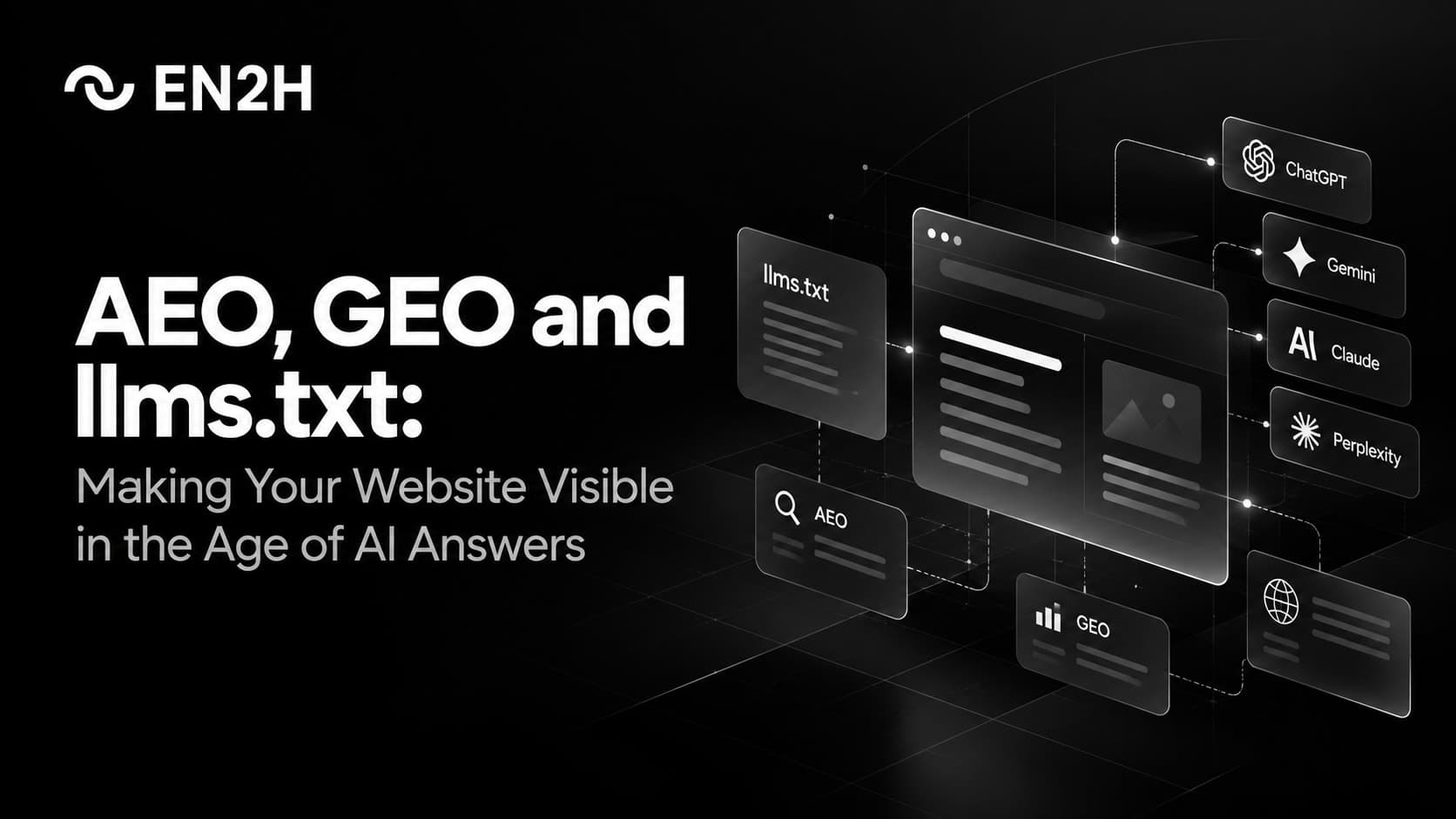
Search is no longer just a list of blue links. People now ask ChatGPT, Gemini, Claude, Perplexity and Google complete questions-and often receive an answer without visiting multiple websites.
This raises an important question for every business:
When AI answers a question about your industry, will it understand and trust your content?
Answer Engine Optimization (AEO), Generative Engine Optimization (GEO) and llms.txt can help businesses prepare for this new search experience. They are not magic shortcuts, but when combined with valuable content and strong SEO, they can make a website clearer and more accessible to both people and AI.
AEO and GEO
Answer Engine Optimization (AEO) means writing content that gives a clear and direct answer to a user’s question.
For example, a business could answer:
How can AI automation reduce manual work?
The page should provide a short answer first, followed by useful details and examples. This makes the content easier to use in featured snippets, voice-search results and AI-generated summaries.
Generative Engine Optimization (GEO) focuses on helping AI tools understand, trust and mention a business in their generated answers.
In simple terms:
AEO helps your content become the answer.
GEO helps your business become a trusted source for that answer.
Businesses can support GEO by publishing accurate information, original insights, real examples and reliable sources.
A 2024 GEO study found that adding useful statistics, quotations and citations could improve content visibility in AI-generated answers by up to 40% in its tests. However, this result does not guarantee the same improvement on every AI platform.
SEO vs AEO vs GEO
SEO, AEO and GEO are related rather than competing strategies.
Area | SEO | AEO | GEO |
Main goal | Rank pages and earn visits | Provide the clearest answer | Be accurately mentioned or cited in generated answers |
Primary focus | Pages and search queries | Questions and direct answers | Brand entities, evidence and credibility |
Typical results | Search-result links | Snippets, voice answers and summaries | AI-generated recommendations and citations |
Key measures | Rankings, clicks and conversions | Answer visibility and assisted conversions | AI mentions, citations, referrals and conversions |
The relationship is straightforward:
SEO helps systems discover the page.
AEO makes its answer clear and extractable.
GEO makes the source credible and useful within a generated response.
Google’s current guidance treats AEO and GEO work for its generative Search experiences as part of SEO. It recommends prioritizing helpful, original content and a clear technical website structure.
How AI Systems Find and Use Web Content
Large language models do not all work in the same way. Depending on the AI product and the user’s question, information may come from:
knowledge learned during model training;
web crawlers and search indexes;
live retrieval of relevant pages;
a URL, document or data source supplied by the user; or
trusted references to a brand across other websites.
For live AI search, a system may find relevant pages, select useful information and use it to create an answer. This process is called Retrieval-Augmented Generation (RAG).
Clear headings, direct answers, current information and reliable sources make content easier for both AI systems and people to understand.
What Is llms.txt?
llms.txt is a proposed Markdown file that gives AI agents a curated guide to a website’s most useful content. It is normally published at:
Jeremy Howard introduced the proposal in September 2024, and version 2 was published in August 2026. The idea is to give an AI agent a short description of an organization and direct links to its authoritative pages.
It is important to understand how llms.txt differs from other website files:
robots.txt manages crawler access to specified website paths.
sitemap.xml provides a broad list of URLs for discovery.
llms.txt provides a curated summary and contextual links that compatible AI agents may choose to read.
It is not a training opt-out file, an official IETF or W3C standard, or a confirmed ranking signal. It cannot force an AI platform to crawl, trust or cite a website.
Its realistic value is simple: if a compatible agent reads the file, it receives a clearer map of the website and can locate authoritative content more quickly.
A Practical llms.txt Example
The version 2 proposal requires an H1 heading. A short summary, explanatory text and sections of Markdown links may follow it. A section called Optional can hold secondary resources.
# Example Company - AI Engineering and Automation
> Example Company builds AI applications, workflow automation and cloud systems for growing businesses.
Use these links for verified information about the company and its services.
## Company
- [About](https://example.com/about): Company background and expertise.
- [Contact](https://example.com/contact): Official enquiry information.
## Services
- [AI Engineering](https://example.com/services/ai): AI agents, automation and intelligent application development.
- [Cloud Engineering](https://example.com/services/cloud): Cloud architecture and modernization services.
## Resources
- [Case Studies](https://example.com/case-studies): Verified project examples and outcomes.
## Optional
- [Company News](https://example.com/news): Announcements and event updates.
How to Create a Useful llms.txt
A good file can be created in five practical steps:
Identify authoritative pages. Select the best company, service, product, documentation, case-study, policy and contact pages.
Write a factual summary. Explain what the company does and who it serves without unsupported marketing claims.
Curate the links. Use absolute HTTPS URLs and add one useful sentence explaining each page.
Publish and test it. Place the file at the website root, confirm that it returns HTTP 200 and ensure it is accessible without a login.
Keep it current. Review the file whenever services, facts or website URLs change.
Publish llms.txt at your website’s root-using the public folder, a Next.js route or a CMS plugin. Keep its linked pages clear, current, well-sourced and easy for both people and AI to read.
The Honest State of Adoption
llms.txt is gaining attention, but its impact remains unproven. Google does not use it for Search rankings, while studies from Ahrefs and SE Ranking found no clear link to greater AI visibility.
Ahrefs reported that 97% of the files studied received no requests. A small number were fetched by AI agents, suggesting possible value for future agent-based workflows-but being fetched does not prove that the content influenced an AI answer.
For most businesses, llms.txt should be treated as a low-cost experimental accessibility layer, not an AI-visibility strategy by itself.
How Businesses Can Improve AI Visibility
Businesses can focus on a short, practical plan:
Identify the questions customers ask before buying or contacting the company.
Create one authoritative page for each important topic.
Answer the main question early and support it with expertise, evidence and examples.
Keep company, product and service information consistent across the web.
Maintain crawlable pages, accurate metadata, internal links, canonical URLs and valid structured data where appropriate.
Publish a small, curated llms.txt as an optional supporting layer.
Track AI mentions, source citations, referral traffic and conversions alongside normal SEO metrics.
No responsible agency can guarantee that an AI platform will cite or recommend a business. The durable approach is to become genuinely useful, technically accessible and easy to verify.
The Bottom Line
Search is no longer only about winning a link-it is about becoming part of the answer.
SEO helps people find you, AEO makes your answers clear, and GEO builds the authority AI systems look for. llms.txt can support this journey, but valuable content and real credibility still matter most.
At EN2H, we build AI-ready platforms and intelligent workflows that turn this opportunity into business value. Book a strategy call with EN2H.
Quick Questions
Does AEO replace SEO?
No. AEO builds on SEO by making content easier to use as a direct answer.
Is llms.txt an official standard?
No. As of September 2026, it remains a community proposal and emerging convention.
Will llms.txt improve rankings?
There is no credible evidence that it improves Google rankings or guarantees more AI citations.